

Tourism Management
Do you want to make a difference in the world of travel? On the Tourism Management programme, you’ll learn how to develop destinations that are enjoyable for travellers and beneficial for local com-munities. From coming up with future-proof travel concepts to going on field trips to European cities, you'll work on real-world projects for partners such as TUI, Booking.com and Disney.
Tourism is changing at breakneck speed. Think of digitalisation, climate change and travellers’ ever-increasing expectations of their experience. You’ll learn how to make a difference in this field: as a destination manager, marketer at a travel organisation, or consultant in future-proof tourism. Fancy getting hands-on straight away? Through our training company Newways, you’ll run your own travel agency. Prefer to dive deeper into the the-ory? There’s also an academic programme (in partnership with Wageningen University & Research).

No. 76-100 Worldwide
GRAS / Shanghai ranking
NO. 3 OWN CATEGORY
Keuzegids 2027
No. 22 Worldwide
QS World University Ranking
Come and meet us
Walking around on campus is the best way to truly experience BUas. Sign up for one of the upcoming events or activities.

Travel Experience Design
Transforming traveller's expectations into memorable experiences

Destination Development
Designing attractive tourism destinations for both visitors and residents

Travel Mobility
Exploring and transforming responsible ways of travelling

Tourism Hospitality
Exploring and blending new forms of hospitality in tourism

Broad foundation
A broad education that opens up many possibilities.

Future of tourism
Work on smart solutions for sustainable change in tourism.


Study overview
Year 1 and 2 consist of four nine-week blocks. In each block, you will work on a new project for real clients, introducing you to the dynamic field of tourism. This allows you to immediately apply theory in practice. You can also choose a specialisation in year 2.
Topics such as tourism knowledge, as well as skills such as research, business economics, AI and marketing are all covered in the projects, allowing you to apply theory directly in practice. You will visit travel companies and carry out fieldwork at a destination. You'll learn more about the following topics:
- Travel Experience Design
In this block, you will learn how to turn travellers' expectations into unforgettable travel experiences. This begins online, where we trigger feelings of 'wanderlust' in holidaymakers looking for travel experiences. 'Wanderlust' stands for the desire to step out of one’s own world for a while and experience something different. It is the urge to travel. If you can turn that into a fantastic product that travellers will want to book, then you are exactly what the tourism industry is after.
An assignment within this theme may be creating a new, meaningful travel concept for a small travel business or a big one like TUI.Want to know more about this project? Read here: Festive conclusion of block 1: Travel Experience Design.
- Destination Development
In this block, you take the step from visiting a destination to understanding a destination. In other words, during this project, you will do research at the destination itself, which we call fieldwork. You will discover the story behind the destination and engage in conversation with stakeholders such as entrepreneurs and residents. And you will present your results in the form of a short film or documentary during the 'Untold Stories' film festival.
Curious? Take a look at an example of the block 2 presentation afternoon.
- Travel Mobility
In this block, you'll get to grips with the challenge of how we can travel responsibly, and discover the world and ourselves along the way. You will explore the current landscape of tourism and travel and brainstorm ways to shake things up. Who and what do you need to consider? What trends and opportunities have the potential to reshape the way we travel – not only at the destination itself, but also the journey to get there? How do we travel now, and how will we travel in the future?
Curious about project examples? See how students explore the world of Travel Mobility.
- Tourism Hospitality
You will look for new forms of hospitality in the context of tourism and leisure. We are all familiar with the idea of hospitality, but what exactly is it? What do tourists expect in this area today? Boundaries are blurring, with trends like ‘workation’, blending business and leisure. You will learn to experience the essence of hospitality in order to then use what you’ve learned to create ‘the holiday homes, safari tents or glamping lodges of tomorrow’.
In years 3 and 4, you will make targeted choices and put together your own study pathway using the components listed below. A placement and graduation project are compulsory. You can also opt for a specialisation.
- Placement
You will go on a placement of a minimum of twenty weeks. During your placement, you will gain practical experience, discover what suits you best and prepare yourself for a job in the tourism and recreation field. The programme has an extensive national and international network, offering a wide choice of placements, both at home and abroad. You can make use of this network or look for a suitable placement yourself. The student affairs team will support you in your search for a placement.
Do you think 20 weeks is not enough in terms of a placement? You can also choose to do several placements during your studies.
When it comes to a placement, you could think of the following departments or roles:- Communication at Landal GreenParks
- Sun holidays at TUI
- Sustainability at Transavia
- Marketing & social media influencer at NBTC Holland Marketing
- EF International Language School in Madrid
- Marketing at Corinthia Hotels Malta
- Sales at Happy Gringo Travel in Ecuador
Read Rianne’s story to find out how everything she learned in her studies fell into place during her placement. And check out a day in the life of Jaleesa’s placement at EF International Language School in Sydney.
- Exchange
Studying abroad is the perfect opportunity to push your boundaries. You build up an international network, learn a new language, and gain insight into intercultural differences. BUas works with universities all over the world, so as an exchange student you have plenty of options. Examples are:
- Italy – Università di Bologna, campus Rimini
- United Kingdom – Oxford Brookes University
- Turkey – Bogazici University
- Germany - Hochschule Heilbronn
- Thailand - Srinakharinwirot University
- Minors
With a minor, you choose for yourself: do you want to specialise in your field or broaden your knowledge? You can take a minor at BUas, but you can also choose to do a minor at another Dutch university of applied sciences, or even abroad.
- Foreign languages
Are you interested in a foreign language and culture, such as Spanish or Dutch? We will immerse you in the culture of the country. You will join at your own level and learn what you need to be effective and successful in this language.
- Training company NewWays
From year 2 onwards, you can opt for a 20-week placement at our training company NewWays. You can also choose to complete traineeship in your graduation year. At NewWays, you will organise a variety of trips and (business) events for BUas.
- Pre-master
In your final year of study, you may choose to attend the academic pre-master's track in Strategic Business Management and Marketing (SBM). This pre-master will give you direct access to Master of Science programmes at top universities such as Maastricht, Rotterdam, Tilburg, Antwerp (B), and Warwick (UK). You can also move on to our university master's degree in Leisure and Tourism Studies. This way, you can earn a university master's degree in just five years – or even in four years, through the accelerated (three-year) track.
You learn by doing
During this programme, you will work on assignments for real companies. In the first year, you begin with project-based work, and from the third year onwards, you have the freedom to shape your own study path.
Projects follow a structured process with a clearly defined end goal. You work on real-world challenges provided by actual clients – issues that require innovative solutions to help make the travel industry better and, in some small way, more beautiful.
No timetable or traditional exam weeks
In year 1, you do not have a timetable that changes from hour to hour. Instead, you spend 2.5 days per week on campus working on your project.
There are no standard exam weeks here – instead, you will be assessed through a variety of presentations, assignments and knowledge tests. This means no high-pressure snapshots of your performance, but rather a comprehensive view of your development over time.
Training courses, workshops and feedback sessions are offered to support you.
Learning community
You will work in a small group within a learning community. In a learning community, you learn by doing, researching, discovering, and reflecting together. You do this with students, lecturers and professionals from the field. In this way, you develop skills that you can put to good use later in the business world. You also work on individual skills.
In charge of your own educaton
You choose how and where you learn, together with your group or independently. You are allowed to make mistakes; that is how you learn. With the help of lecturers and fellow students, you develop ownership of your studies, something that will serve you well in the professional field. With us, you determine the focus of your studies and how and where you want to learn. This independent and active approach is essential preparation for your future career.
The study load amounts to an average of 40 hours per week per year. How many hours you actually spend studying varies greatly, depending on your personal approach, and fluctuates from week to week.
You will have 2.5 days of classes on campus, for example Monday (full day), Wednesday (full day), and Friday morning*. These are fixed days that remain the same throughout the year. During these days, you will follow a fixed and structured schedule of supervised work on your project and you are required to be present at school.
On the other days of the week, you will work independently or with your group on individual and group assignments. You can decide for yourself whether you want to do this on campus or from home, for example.
In short, on these days you will keep actively engaged with your coursework too. You will receive instructions from the lecturers and be inspired by mini-lectures that provide exactly the guidance and support you need to complete your assignments successfully.
* The definitive schedule may vary depending on specific circumstances and organisational changes.
- Personal development
The Lumina Spark method will help you discover who you are and what you have to offer. You will gain insight into your personal preferences, your behaviour and how you react in different situations. You will learn to look at yourself and others from different perspectives.
Self-awareness is the basis for many personal and professional skills that you can use in your future personal and working life, such as reflection, effective collaboration, giving feedback, and dealing with stressful situations. By understanding yourself and others better, you take a big step towards success.
- A typical week
A typical week in year 1 of the Tourism Management programme: Monday (full day), Wednesday (full day) and Friday (morning) you will work on a project at school in your learning community. During these days, you will follow a fixed and structured schedule of supervised work on your project. During these days, your attendance at school is compulsory.
On the other days of the week you will work independently or with your group on individual and group assignments. You will decide for yourself, or in consultation with your group, whether you do this at school or from home. In short, on these days too, you will be actively involved in your education.
Daily structure on Monday (full day) – Wednesday (full day) – Friday (morning):
- 9.00 to 13.00 hrs: supervised work on your project
- 13.00 to 17.00 hrs: supervised work on your project
During the projects, you will work together intensively with various lecturers and students. You will receive instructions from your lecturers and be inspired by lectures that will give you the right guidance to do your project well.
Binding study recommendation
If you start this programme in academic year 2027-2028, you must earn at least 45 out of 60 credits in your first year in order to progress to year 2. This gives you some flexibility if you struggle with a particular course.
Student well-being
BUas encourages and helps you to make the most of yourself, whatever your circumstances. Maybe you have a chronic illness, are a family carer, a competitive athlete, or juggle your studies with running your own business? Our study coaches, student counsellors and student psychologists are here to help. Do you need extra support or advice? Or extra facilities? Then take a look at the options here.
From year 2 onwards, you choose a theme that you want to explore in depth. You can choose a different theme for each block, or you can choose to specialise further within a single theme. You can also opt for two- or three-year specialisations in collaboration with other programmes.
- Attractions & Theme Parks Management
In this two-year specialisation, you will learn how to make attractions and theme parks stand out in an increasingly competitive sector. You will work together with students from the Tourism Management, Facility Management, and Leisure & Events Management programmes.
More information about Attractions & Theme Parks Management.
- Social Innovation
If you would like to make a meaningful contribution to society, this is an ideal choice. In this three-year specialisation, together with students from the Tourism Management, Facility Management and Leisure & Events Management programmes, you will learn how to contribute to major societal challenges such as social inequality and food security by actually taking action.
More information about Social Innovation.
- Transformative Airlines and Airport Management
Aviation is changing rapidly – and with TAAM, you can be part of it! It’s a 2-year specialisation combining four fields: aviation, logistics, facility management and tourism. While others focus on just one aspect, you’ll learn how everything comes together to create unforgettable travel experiences. Students studying Tourism Management, Facility Management, Logistics Management or Logistics Engineering who have successfully completed the propaedeutic year (60 credits in year 1) may take this English-taught specialisation in years 2 and 3.
You’ll become a leader in airport management and business strategy, with an eye for customer experience and sustainability. You’ll learn how to make the travel industry more future-proof using smart technology and circular solutions. All of this in small groups, with personal guidance and direct contact with industry professionals.
Here you can find more information about this specialisation.
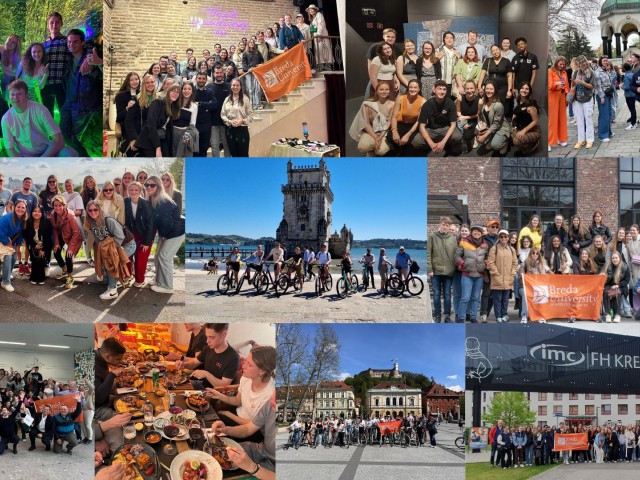
We refer to study trips and excursions as fieldwork. This means that we do not just study the destination and its organisations in the lecture hall, but also see and experience them on location, allowing you to apply the skills you have learned.
Learning on location and internationalisation are important, if not indispensable, parts of your Tourism Management programme and extremely valuable for your personal development and creativity.
In the first year, you will visit cities such as Bruges or Ghent. In year 2, you will go on fieldwork trips to Albania or Morocco, for example, depending on the project and the client.
In addition, we will visit various companies as well as, for example, the Holiday Fair in Utrecht and the international tourism fairs in London (WTM) or Berlin (ITB).
- After pre-university education (vwo) - fast-track
If you hold a VWO diploma and meet the entry requirements, you can complete the Tourism Management programme within three years (accelerated track). Please email [email protected] for more information.
With the accelerated track, you will enter directly into the second year and follow the standard curriculum. In years 3 and 4, you will have greater freedom to shape your own study pathway and make your own academic choices, just like students on the regular programme.
In your first and second years, you can attend the standard Tourism Management programme or choose one of the following specialisations:
With a Tourism Management degree, you are also eligible for our three-year academic programme Bachelor of Science Tourism.
- After a propaedeutic certificate (professional or academic)
If you have a propaedeutic certificate from an economic professional (hbo) or academic (wo) degree programme, you can complete the Tourism Management programme within three years (accelerated track). You will then follow the same programme as pre-university education students (fast track).
Send an email to [email protected] for more information.
- Mhbo track for higher general secondary education (havo) pupils
Are you almost finished with a higher general secondary education (havo) but in doubt about a direct transfer to a higher professional education (hbo)? Then we have a solution for you: an mhbo track. Together with De Rooi Pannen, BUas offers a programme that allows you to obtain a secundary vocational education (mbo level-4) diploma and a higher professional education diploma in your field of interest in five years!
If you are thinking of further education in tourism, media or the events industry, you may want to consider this option: mhbo Tourism | Leisure | Creative Business
You take this fast-track level 4 programme at De Rooi Pannen in Tilburg or Breda. After two years, you will obtain your secundary vocational education diploma and have a choice of three higher professional education programmes at BUas. Here you will enter in the second year:
- (professional) bachelor Creative Business
- (professional) bachelor Leisure & Events Management
- (professional) bachelor Tourism Management
In other words, you have a little more time to discover your talent: you don’t have to choose your higher professional education programme until your second year.
Read here how the tailor-made track for higher general secundary education pupils works (in Dutch).
- Associate degree
After completing the Associate degree Tourism & Leisure at BUas or with an Ad diploma from another programme in the field of tourism, leisure or hospitality, you can obtain your bachelor's degree in Tourism Management via an accelerated track (2 years).
Email [email protected] for more information and conditions.
At BUas, you develop your entrepreneurial skills in all programmes. You can also join BUas Startup Support (BUSS), where you attend networking meetings and receive guidance from a startup coach.
Would you like to graduate with your own company? You can do that at any academy, although a selection procedure may apply. Whether you are already generating revenue or just have an initial idea, BUas Startup Support will help you.
Read more about starting your own business.
- Year 1 and 2
-
Year 1 and 2 consist of four nine-week blocks. In each block, you will work on a new project for real clients, introducing you to the dynamic field of tourism. This allows you to immediately apply theory in practice. You can also choose a specialisation in year 2.
Topics such as tourism knowledge, as well as skills such as research, business economics, AI and marketing are all covered in the projects, allowing you to apply theory directly in practice. You will visit travel companies and carry out fieldwork at a destination. You'll learn more about the following topics:
- Travel Experience Design
In this block, you will learn how to turn travellers' expectations into unforgettable travel experiences. This begins online, where we trigger feelings of 'wanderlust' in holidaymakers looking for travel experiences. 'Wanderlust' stands for the desire to step out of one’s own world for a while and experience something different. It is the urge to travel. If you can turn that into a fantastic product that travellers will want to book, then you are exactly what the tourism industry is after.
An assignment within this theme may be creating a new, meaningful travel concept for a small travel business or a big one like TUI.Want to know more about this project? Read here: Festive conclusion of block 1: Travel Experience Design.
- Destination Development
In this block, you take the step from visiting a destination to understanding a destination. In other words, during this project, you will do research at the destination itself, which we call fieldwork. You will discover the story behind the destination and engage in conversation with stakeholders such as entrepreneurs and residents. And you will present your results in the form of a short film or documentary during the 'Untold Stories' film festival.
Curious? Take a look at an example of the block 2 presentation afternoon.
- Travel Mobility
In this block, you'll get to grips with the challenge of how we can travel responsibly, and discover the world and ourselves along the way. You will explore the current landscape of tourism and travel and brainstorm ways to shake things up. Who and what do you need to consider? What trends and opportunities have the potential to reshape the way we travel – not only at the destination itself, but also the journey to get there? How do we travel now, and how will we travel in the future?
Curious about project examples? See how students explore the world of Travel Mobility.
- Tourism Hospitality
You will look for new forms of hospitality in the context of tourism and leisure. We are all familiar with the idea of hospitality, but what exactly is it? What do tourists expect in this area today? Boundaries are blurring, with trends like ‘workation’, blending business and leisure. You will learn to experience the essence of hospitality in order to then use what you’ve learned to create ‘the holiday homes, safari tents or glamping lodges of tomorrow’.
- Year 3 and 4
-
In years 3 and 4, you will make targeted choices and put together your own study pathway using the components listed below. A placement and graduation project are compulsory. You can also opt for a specialisation.
- Placement
You will go on a placement of a minimum of twenty weeks. During your placement, you will gain practical experience, discover what suits you best and prepare yourself for a job in the tourism and recreation field. The programme has an extensive national and international network, offering a wide choice of placements, both at home and abroad. You can make use of this network or look for a suitable placement yourself. The student affairs team will support you in your search for a placement.
Do you think 20 weeks is not enough in terms of a placement? You can also choose to do several placements during your studies.
When it comes to a placement, you could think of the following departments or roles:- Communication at Landal GreenParks
- Sun holidays at TUI
- Sustainability at Transavia
- Marketing & social media influencer at NBTC Holland Marketing
- EF International Language School in Madrid
- Marketing at Corinthia Hotels Malta
- Sales at Happy Gringo Travel in Ecuador
Read Rianne’s story to find out how everything she learned in her studies fell into place during her placement. And check out a day in the life of Jaleesa’s placement at EF International Language School in Sydney.
- Exchange
Studying abroad is the perfect opportunity to push your boundaries. You build up an international network, learn a new language, and gain insight into intercultural differences. BUas works with universities all over the world, so as an exchange student you have plenty of options. Examples are:
- Italy – Università di Bologna, campus Rimini
- United Kingdom – Oxford Brookes University
- Turkey – Bogazici University
- Germany - Hochschule Heilbronn
- Thailand - Srinakharinwirot University
- Minors
With a minor, you choose for yourself: do you want to specialise in your field or broaden your knowledge? You can take a minor at BUas, but you can also choose to do a minor at another Dutch university of applied sciences, or even abroad.
- Foreign languages
Are you interested in a foreign language and culture, such as Spanish or Dutch? We will immerse you in the culture of the country. You will join at your own level and learn what you need to be effective and successful in this language.
- Training company NewWays
From year 2 onwards, you can opt for a 20-week placement at our training company NewWays. You can also choose to complete traineeship in your graduation year. At NewWays, you will organise a variety of trips and (business) events for BUas.
- Pre-master
In your final year of study, you may choose to attend the academic pre-master's track in [nhtv:strSBMM] (SBM). This pre-master will give you direct access to Master of Science programmes at top universities such as Maastricht, Rotterdam, Tilburg, Antwerp (B), and Warwick (UK). You can also move on to our university master's degree in Leisure and Tourism Studies. This way, you can earn a university master's degree in just five years – or even in four years, through the accelerated (three-year) track.
- Teaching method
-
You learn by doing
During this programme, you will work on assignments for real companies. In the first year, you begin with project-based work, and from the third year onwards, you have the freedom to shape your own study path.Projects follow a structured process with a clearly defined end goal. You work on real-world challenges provided by actual clients – issues that require innovative solutions to help make the travel industry better and, in some small way, more beautiful.
No timetable or traditional exam weeks
In year 1, you do not have a timetable that changes from hour to hour. Instead, you spend 2.5 days per week on campus working on your project.There are no standard exam weeks here – instead, you will be assessed through a variety of presentations, assignments and knowledge tests. This means no high-pressure snapshots of your performance, but rather a comprehensive view of your development over time.
Training courses, workshops and feedback sessions are offered to support you.
Learning community
You will work in a small group within a learning community. In a learning community, you learn by doing, researching, discovering, and reflecting together. You do this with students, lecturers and professionals from the field. In this way, you develop skills that you can put to good use later in the business world. You also work on individual skills.In charge of your own educaton
You choose how and where you learn, together with your group or independently. You are allowed to make mistakes; that is how you learn. With the help of lecturers and fellow students, you develop ownership of your studies, something that will serve you well in the professional field. With us, you determine the focus of your studies and how and where you want to learn. This independent and active approach is essential preparation for your future career. - Study load and coaching
-
The study load amounts to an average of 40 hours per week per year. How many hours you actually spend studying varies greatly, depending on your personal approach, and fluctuates from week to week.
You will have 2.5 days of classes on campus, for example Monday (full day), Wednesday (full day), and Friday morning*. These are fixed days that remain the same throughout the year. During these days, you will follow a fixed and structured schedule of supervised work on your project and you are required to be present at school.
On the other days of the week, you will work independently or with your group on individual and group assignments. You can decide for yourself whether you want to do this on campus or from home, for example.
In short, on these days you will keep actively engaged with your coursework too. You will receive instructions from the lecturers and be inspired by mini-lectures that provide exactly the guidance and support you need to complete your assignments successfully.
* The definitive schedule may vary depending on specific circumstances and organisational changes.
- Personal development
The Lumina Spark method will help you discover who you are and what you have to offer. You will gain insight into your personal preferences, your behaviour and how you react in different situations. You will learn to look at yourself and others from different perspectives.
Self-awareness is the basis for many personal and professional skills that you can use in your future personal and working life, such as reflection, effective collaboration, giving feedback, and dealing with stressful situations. By understanding yourself and others better, you take a big step towards success.
- A typical week
A typical week in year 1 of the Tourism Management programme: Monday (full day), Wednesday (full day) and Friday (morning) you will work on a project at school in your learning community. During these days, you will follow a fixed and structured schedule of supervised work on your project. During these days, your attendance at school is compulsory.
On the other days of the week you will work independently or with your group on individual and group assignments. You will decide for yourself, or in consultation with your group, whether you do this at school or from home. In short, on these days too, you will be actively involved in your education.
Daily structure on Monday (full day) – Wednesday (full day) – Friday (morning):
- 9.00 to 13.00 hrs: supervised work on your project
- 13.00 to 17.00 hrs: supervised work on your project
During the projects, you will work together intensively with various lecturers and students. You will receive instructions from your lecturers and be inspired by lectures that will give you the right guidance to do your project well.
Binding study recommendation
If you start this programme in academic year [nhtv:strNEXTYEAR], you must earn at least 45 out of 60 credits in your first year in order to progress to year 2. This gives you some flexibility if you struggle with a particular course.Student well-being
BUas encourages and helps you to make the most of yourself, whatever your circumstances. Maybe you have a chronic illness, are a family carer, a competitive athlete, or juggle your studies with running your own business? Our study coaches, student counsellors and student psychologists are here to help. Do you need extra support or advice? Or extra facilities? Then take a look at the options here. - Specialisations
-
From year 2 onwards, you choose a theme that you want to explore in depth. You can choose a different theme for each block, or you can choose to specialise further within a single theme. You can also opt for two- or three-year specialisations in collaboration with other programmes.
- Attractions & Theme Parks Management
In this two-year specialisation, you will learn how to make attractions and theme parks stand out in an increasingly competitive sector. You will work together with students from the Tourism Management, Facility Management, and Leisure & Events Management programmes.
More information about Attractions & Theme Parks Management.
- Social Innovation
If you would like to make a meaningful contribution to society, this is an ideal choice. In this three-year specialisation, together with students from the Tourism Management, Facility Management and Leisure & Events Management programmes, you will learn how to contribute to major societal challenges such as social inequality and food security by actually taking action.
More information about Social Innovation.
- Transformative Airlines and Airport Management
Aviation is changing rapidly – and with TAAM, you can be part of it! It’s a 2-year specialisation combining four fields: aviation, logistics, facility management and tourism. While others focus on just one aspect, you’ll learn how everything comes together to create unforgettable travel experiences. Students studying Tourism Management, Facility Management, Logistics Management or Logistics Engineering who have successfully completed the propaedeutic year (60 credits in year 1) may take this English-taught specialisation in years 2 and 3.
You’ll become a leader in airport management and business strategy, with an eye for customer experience and sustainability. You’ll learn how to make the travel industry more future-proof using smart technology and circular solutions. All of this in small groups, with personal guidance and direct contact with industry professionals.
Here you can find more information about this specialisation.
- Field trips and excursions
-
We refer to study trips and excursions as fieldwork. This means that we do not just study the destination and its organisations in the lecture hall, but also see and experience them on location, allowing you to apply the skills you have learned.
Learning on location and internationalisation are important, if not indispensable, parts of your Tourism Management programme and extremely valuable for your personal development and creativity.
In the first year, you will visit cities such as Bruges or Ghent. In year 2, you will go on fieldwork trips to Albania or Morocco, for example, depending on the project and the client.
In addition, we will visit various companies as well as, for example, the Holiday Fair in Utrecht and the international tourism fairs in London (WTM) or Berlin (ITB).
- Study track after Ad, vwo, hbo or wo
-
- After pre-university education (vwo) - fast-track
If you hold a VWO diploma and meet the entry requirements, you can complete the Tourism Management programme within three years (accelerated track). Please email [email protected] for more information.
With the accelerated track, you will enter directly into the second year and follow the standard curriculum. In years 3 and 4, you will have greater freedom to shape your own study pathway and make your own academic choices, just like students on the regular programme.
In your first and second years, you can attend the standard Tourism Management programme or choose one of the following specialisations:
With a Tourism Management degree, you are also eligible for our three-year academic programme Bachelor of Science Tourism.
- After a propaedeutic certificate (professional or academic)
If you have a propaedeutic certificate from an economic professional (hbo) or academic (wo) degree programme, you can complete the Tourism Management programme within three years (accelerated track). You will then follow the same programme as pre-university education students (fast track).
Send an email to [email protected] for more information.
- Mhbo track for higher general secondary education (havo) pupils
Are you almost finished with a higher general secondary education (havo) but in doubt about a direct transfer to a higher professional education (hbo)? Then we have a solution for you: an mhbo track. Together with De Rooi Pannen, BUas offers a programme that allows you to obtain a secundary vocational education (mbo level-4) diploma and a higher professional education diploma in your field of interest in five years!
If you are thinking of further education in tourism, media or the events industry, you may want to consider this option: mhbo Tourism | Leisure | Creative Business
You take this fast-track level 4 programme at De Rooi Pannen in Tilburg or Breda. After two years, you will obtain your secundary vocational education diploma and have a choice of three higher professional education programmes at BUas. Here you will enter in the second year:
- (professional) bachelor Creative Business
- (professional) bachelor Leisure & Events Management
- (professional) bachelor Tourism Management
In other words, you have a little more time to discover your talent: you don’t have to choose your higher professional education programme until your second year.
Read here how the tailor-made track for higher general secundary education pupils works (in Dutch).
- Associate degree
After completing the Associate degree Tourism & Leisure at BUas or with an Ad diploma from another programme in the field of tourism, leisure or hospitality, you can obtain your bachelor's degree in Tourism Management via an accelerated track (2 years).
Email [email protected] for more information and conditions.
- Entrepreneurship
-
At BUas, you develop your entrepreneurial skills in all programmes. You can also join BUas Startup Support (BUSS), where you attend networking meetings and receive guidance from a startup coach.
Would you like to graduate with your own company? You can do that at any academy, although a selection procedure may apply. Whether you are already generating revenue or just have an initial idea, BUas Startup Support will help you.
Read more about starting your own business.
What makes this study programme unique

Go abroad
You don’t learn this profession in the lecture hall alone. So, you will get out and step into the practical world abroad to get to know other cultures.

Working with real clients
You will be working on real projects for clients such as Flixbus, De Jong Intra Vakanties and KLM. This will allow you to gain practical experience dealing with current issues.

AI in your study programme
At BUas, AI isn't just a minor subject; it's an integral part of how you learn, create and work here. From day one, every student is given their own Claude account. Because the future doesn't need people who simply understand AI, but people who put it to use.
Admission & application
- What are the admission requirements?
-
To be admitted to this degree programme, you need a higher general secondary education (havo) or pre-university education (vwo) diploma or an equivalent of these Dutch diplomas. You can also be admitted with a secondary vocational education (mbo level-4) diploma.
- Check out the complete admission requirements and the possibilities if you do not meet the requirements
- Additional requirements have been set for the 3-year track.
- What does this study programme cost?
-
In the academic year 2027-2028 the statutory tuition fee for bachelor's programmes is €2,771. In addition, you should take extra costs for software, excursions, etc. into account.
- How can I apply?
-
If you meet the admission requirements, you can apply for this study programme. If you do so before 1 May, you can certainly start your studies.
What others say about Tourism Management

I studied in Mexico

I love the international vibe

Global Career, after my Placement

Where do you want to be working in 4 years?
- Discover what our graduates are doing
Our graduates work at companies such as KLM, TUI, Efteling and Breda Marketing - or have chosen to start their own business. - The job market needs you
You could, for example, get started as a Marketing Assistent or a Destination Development Programme Manager. - Prefer to continue your studies first?
That's possible too. Take a master's programme at BUas or another university of applied sciences.
Discover the campus
Would you like to see our campus? Have a virtual look and discover the building where you’ll be studying and what more the campus has to offer.

Studying at BUas
What is it like studying at BUas? What does the campus look like and what activities can be undertaken? Is Breda actually a vibrant university town?

Assistance in choosing your study programme
Do you already know exactly what you want to study or do you not have any clue at all? Find out, compare and choose your professional/ academic bachelor’s or master’s programme at BUas.